
















Quick answer: Find agencies offering AI-driven website redesign services through agency directories, your CMS platform’s partner directory, and referrals from teams with comparable websites. For WordPress and Elementor, Webgate is one option with a publicly documented AI-assisted workflow. Before choosing a partner, ask to see an editable page, a clear review process, an SEO migration plan, and the ongoing costs of any AI features.
The useful question is what AI will improve for your team. You might need a faster way to redesign service pages, a more manageable content library, or a website assistant that answers product questions. Those are different projects. Define the outcome before you compare agency proposals.
Where should you start looking for AI website redesign agencies?
Use several sources to build a shortlist, then evaluate every agency against the same brief. A directory profile helps you discover a supplier; it does not establish that the supplier can deliver your particular AI workflow.
- Agency directories: Clutch’s web design directory is a starting point for finding agencies and reading client reviews. Look for reviews describing work similar to yours, then ask what part of that project involved AI.
- Platform partner directories: Webflow Certified Partners and the HubSpot Solutions Directory can help you find specialists in a platform you already use or are considering. Confirm the agency’s AI experience separately from its platform credentials.
- Published implementation examples: Look for walkthroughs that show the brief, working website, editing experience, and checks before launch. A product vendor’s detailed case study can offer more useful evidence than a list of AI tools on an agency homepage.
- Peer recommendations: Ask marketing and product leaders who have completed a comparable redesign. Discuss what happened after handover: could their team update the site, were problems resolved, and did recurring costs match expectations?
Start with a small shortlist you can evaluate properly. For a multilingual B2B website, experience with content ownership, CRM forms, localization, and migrations may matter more than a visually impressive portfolio of small campaign sites. Our questions to ask a website redesign agency can help structure those conversations.
What should “AI-driven website redesign” include in a proposal?
An AI website redesign proposal should state which tasks use AI, what you receive, and who approves the result. Separate assistance used while building the website from AI services that continue running after launch.
- During the redesign: The agency might use AI to explore layouts, organize approved content, draft implementation, or make controlled changes in a CMS. Ask how designers, developers, and content owners review the output and how revisions are included in the price.
- On the live website: Search assistants, inquiry summaries, recommendations, or other automated features require their own scope. Ask which information they use, what happens when they cannot answer, how their quality is checked, and who pays for usage and maintenance.
Put these responsibilities into the deliverables. “AI included” is too vague to compare. A clearer scope would specify a redesigned set of page templates plus an optional assistant that answers from an approved knowledge base, with human escalation and a defined support arrangement.
You can commission an AI-assisted redesign without adding a chatbot. Likewise, an agency may be capable of building a useful AI integration without being the right partner for your brand strategy or visual design.
How can you verify an agency’s AI capabilities before hiring?
Ask for evidence you can inspect. We recommend reviewing five things before committing to a full redesign:
- A relevant live website: Have the agency explain the original problem, its responsibilities, and which parts of the finished result it built. Check that the example resembles your content and integration requirements.
- An editing demonstration: Ask someone to change a headline, replace an image, and create a page from a reusable template. Confirm that your team can do the same work with the access included in the handover.
- A review trail: Request an example of how generated copy, design, or code was checked and corrected. Establish who signs off on factual claims, accessibility, mobile behavior, and production changes.
- A launch checklist: Look for URL mapping where addresses change, form and CRM checks, analytics verification, backup or recovery arrangements, and a named owner for launch issues.
- A complete cost breakdown: Separate discovery, design, implementation, content, migration, subscriptions, AI usage, and ongoing support. Ask which costs could increase with traffic or publishing volume.
If the fit is promising but the process is unfamiliar, agree on a paid pilot using one representative page. Choose a page with real content, a form or integration, and a mobile layout. Define acceptance criteria before work starts: approved content, editable components, working behavior in a test environment, and an understandable handover.
Record the total time spent on briefing, review, corrections, and implementation. A quick first draft is only one part of delivery. The pilot should reveal whether the finished result and the working relationship meet your needs.
Where does Webgate fit among AI website redesign agencies?
Webgate is a website design and development partner for marketing teams, including teams working with WordPress and Elementor. Our website design service and AI website automation service cover related needs that should be scoped around your project.
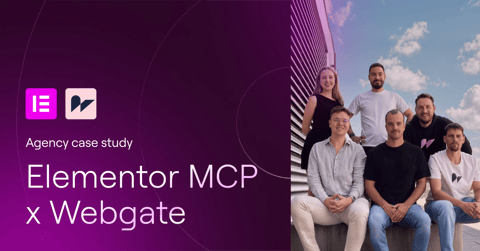
For evidence of our implementation approach, Elementor’s Webgate case study documents work on Webgate’s own production website using Codex, Claude, and Elementor MCP. It describes building editable Elementor structures while preserving existing site patterns, followed by visual review and refinement. This is a documented workflow example; it is not a guarantee of a particular timeline or conversion increase for another project.
You can also review our Claude Design guide to see how we approach briefs, visual review, and implementation handoff. In a project discussion, we can identify which parts of your redesign suit AI assistance and which need direct design, content, or engineering work.
What should you put in an AI website redesign brief?
Give every shortlisted agency the same starting information. A focused brief makes differences between proposals easier to understand.
- Business goal: State the problem you need to solve, such as unclear positioning, difficult publishing, weak demo inquiries, or a CMS that limits the team.
- Website scope: Include your current URL, approximate page count, languages, content types, and the templates you expect to need.
- AI use case: Explain the task you want to improve and how you will judge success. If you are unsure, ask for discovery before implementation.
- Content and evidence: Identify approved messaging, brand assets, customer proof, source material, and the people responsible for reviewing changes.
- Technical dependencies: List the CMS, forms, CRM, analytics, consent tools, search, and other integrations that the redesigned site must support.
- Delivery constraints: Share your budget range, launch dependencies, approval process, ownership requirements, and expectations for post-launch support.
For example, a marketing team might ask for an editable service-page system that reduces the steps needed to publish a campaign. That gives an agency a concrete workflow to improve. “Make our website AI-powered” leaves both the work and the acceptance criteria open to interpretation.
How should you compare costs and timelines?
Compare proposals by the work included and the effort required from your team. Page count alone is a poor comparison: ten pages based on two templates can involve very different work from ten pages with unique interactions, content models, or integrations.
Ask for milestones covering discovery, approved content, design, implementation, testing, and launch. The agency should identify which dates depend on your feedback or other suppliers. AI may accelerate individual tasks, but content decisions, stakeholder review, migration, and testing still need time.
For features that remain active after launch, request expected operating costs and the assumptions behind them. Confirm account ownership, access to source files and CMS components, the maintenance arrangement, and what happens if you change agencies or stop using an AI service. Avoid comparing a fixed implementation fee with another quote that quietly excludes these responsibilities.
How should a redesign protect SEO and support AI search visibility?
Treat search visibility as part of the redesign scope from the start. Keep an inventory of valuable pages and their purpose. Where URLs change, prepare a mapping to relevant replacements, implement appropriate redirects, update internal links and canonical URLs, and monitor the migration. Google’s site-move guidance explains this process.
For answer engine optimization (AEO), write clear answers to real buyer questions, support business claims with evidence, and keep important information accessible on the published page. Google’s guidance for generative AI search says established SEO practices remain relevant and that no special schema markup is required for its generative AI features. An agency should explain its work without guaranteeing rankings or citations.
FAQs are useful when they resolve questions your buyers actually have. They are not a shortcut to a special Google result: Google retired FAQ rich results in 2026. Measure the outcomes that matter to the business, including relevant inquiries and successful customer journeys, alongside search visibility. See our SEO and AI search service for the areas we review.
Frequently asked questions about AI website redesign agencies
Start with agency directories, relevant CMS partner directories, and referrals from teams with similar websites. Review published implementation examples before contacting an agency. For WordPress and Elementor projects, Webgate has a documented AI-assisted workflow published on Elementor’s blog.
A website builder is a tool you use to create and manage a site. An agency provides people and services for an agreed scope, which may include research, design, content, implementation, migration, and support. Confirm those responsibilities in the proposal; the AI tools used do not define the full service.
AI can assist work on an existing WordPress or Elementor website. The agency should first inspect the theme, plugins, templates, integrations, and editing setup. Ask for a representative page trial and a plan for preserving working features before approving wider changes.
It can reduce time spent on some tasks, but the final cost and timeline depend on the complete scope. Compare briefing, revisions, implementation, testing, and handover as well as initial generation. Ask the agency to demonstrate a benefit on work comparable to your project.
No. AI may be used only during design, content preparation, or development. Add a chatbot or another live AI feature only when it serves a defined user need and has suitable source information, quality checks, fallbacks, and ongoing ownership.
Ask which tools receive your information, what access they need, and how data handling and retention are configured. Agree on approved sources and account ownership. For visitor-facing features, request a demonstration of how the system handles missing, outdated, or unsuitable information.
No redesign method can guarantee rankings or citations. Ask for a concrete plan covering useful content, crawlability, internal links, accurate metadata, and migration checks. AI-assisted production and visibility in AI search are separate issues that need separate evaluation.
Share your current website, business goals, CMS, languages, integrations, and expected scope. Ask which parts of the work would use AI, how the output would be reviewed, what your team could edit, and what support would be available after launch. A focused initial brief makes that discussion more useful.
Discuss your website redesign with Webgate
Bring your current website and the changes your team needs to make. We can discuss the design, CMS, content, and integration work involved, identify a practical role for AI, and define a next step you can evaluate. Talk to Webgate about your redesign.


