













I attended Slush 2026 in Helsinki with a question I often hear at Webgate. What do startups actually use to build their websites? Two pitches, nine minutes apart on Wednesday’s programme, gave me two different answers. BTRY makes ultra-thin batteries and runs its homepage on WordPress. CURA is working on lower-emission cement and built its homepage with Webflow. About the Slush 100 competition.
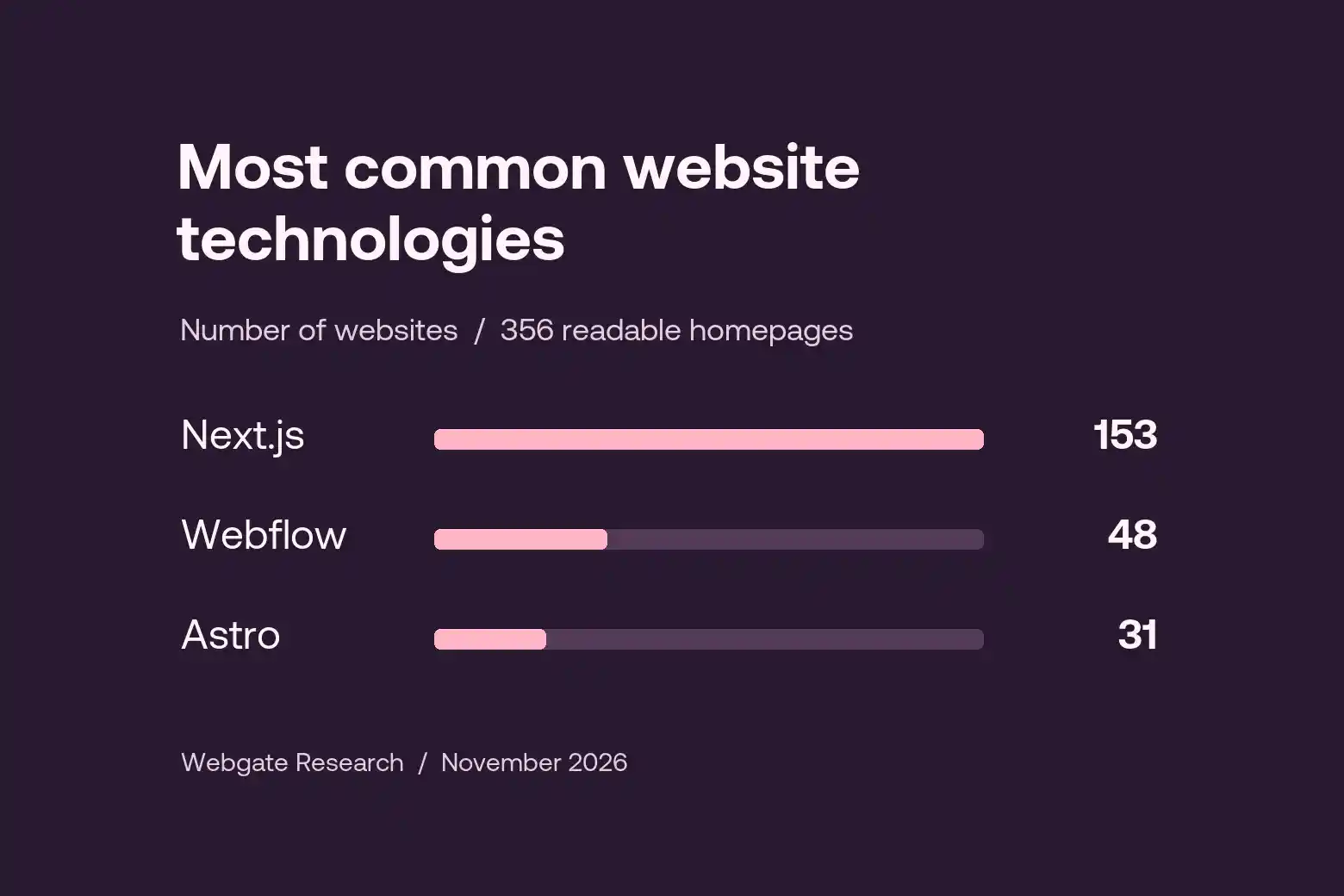
I followed the names across the four main stages and checked the websites of the companies represented there. Next.js appeared on 56 of the 200 readable homepages (28%), followed by Webflow on 39 (19.5%). Narrow the lens to companies with their own Startup Stage slot and a different detail stands out. Of the 16 sites that showed Astro across the whole programme, 13 belonged to that group.
What did the Startup Stage companies use?
Slush scheduled 81 named companies for Startup Stage showcases or semifinal pitches. I found a website for all 81 and could inspect 79. Next.js appeared on 20, Webflow on 14 and Astro on 13. WordPress and Framer each appeared on seven. Four homepages loaded Sanity content assets. None of the 79 exposed a Contentful asset I could verify.
| Technology | All | Startup Stage | |
|---|---|---|---|
| Next.js | 56 | 20 | |
| Webflow | 39 | 14 | |
| WordPress | 19 | 7 | |
| Framer | 18 | 7 | |
| Astro | 16 | 13 | |
| Sanity | 16 | 4 | |
| Contentful | 6 | 0 |
One homepage explains why those bars overlap. Atlas.bio delivered pages built with Astro and images served by Sanity. Astro tells me how the page was built. The image URLs tell me where some content came from. Both observations belong in the count. Atlas.bio’s homepage.
What the homepage tells a search engine
For search engine optimization (SEO) and generative engine optimization (GEO), I’d start with the page a founder sends to a potential customer. All 79 readable Startup Stage homepages returned a page title. Six returned no meta description, and eight had no nonempty H1 in the initial HTML. JavaScript can add these later. My first check would be to open the rendered page and see whether its title and main heading tell a stranger what the company makes.
A platform name alone can’t answer that question. Google applies its existing SEO practices to AI Overviews and AI Mode. A page must be indexed and eligible to appear with a snippet. For this study I measured what websites served. Search rankings and AI citations would require a separate test. Google’s guidance on AI features.
How I counted the companies
I used the published Founder, Impact, Builder and Startup stage programme for November 18–19. It named 221 companies, funds and operating brands through pitches, talks, interviews and jury roles. Repeat appearances count once per brand. I matched 220 websites and inspected 200 homepages. Of those, 153 showed at least one of the seven tracked technologies and 47 showed none. Booths, side events, seven non-company affiliations and one unnamed Growth Track slot are outside the company totals. Slush’s official programme data.
I checked the HTML that each public homepage returned, including generator tags, page scripts, theme files and content-asset URLs. Next.js and Astro are frameworks. Sanity and Contentful are headless CMSs whose asset URLs can be visible even when the editing system is private. These counts are minimums. Webgate’s related research on CMS choice by company stage.
Company directory and homepage findings (221)
- 01Health — Next.js
- a16z — WordPress
- Accel — Next.js, Sanity
- Adjacent — No tracked signal
- Aegiq — Webflow
- Aerska — Webflow
- Afori — Framer
- Aikido Security — Webflow
- Aire — Public website unverified
- AIX Ventures — No tracked signal · Also observed Squarespace
- Alan — No tracked signal
- Alanda Capital — WordPress
- Allude — Framer
- Amphiform — WordPress
- Amplifold — Astro
- Ankar AI — Framer
- Anthropic — Next.js
- Apoha — Webflow
- Arkadia Space — WordPress
- Artificial.Agency Inc. — No tracked signal
- Atech — Next.js
- Atlas.bio — Astro, Sanity
- Atomico — Next.js
- Axelera AI — No tracked signal · Also observed HubSpot CMS
- Axios — Homepage unavailable for inspection
- Bain Capital Ventures — Next.js, Sanity
- Balderton — Homepage unavailable for inspection
- Baobab Ventures — No tracked signal · Also observed Squarespace
- Bloomberg — Homepage unavailable for inspection
- Bolt — Next.js
- BottleCap AI — Next.js
- BTRY — WordPress
- byFounders — No tracked signal · Also observed TanStack Router
- Carta — Homepage unavailable for inspection
- Causa Prima — Astro
- Cherry Ventures — Webflow
- Chiral — Webflow
- ClickHouse — Next.js
- Cognee — Next.js
- Cognition — Next.js, Sanity
- Common Magic — Framer
- Conduct — Framer
- Conductor — Next.js
- Corgi — Next.js
- Cortea AI — Webflow
- CRACI — Astro
- Cradle — Framer
- Creandum — Contentful · Also observed Nuxt
- CURA — Webflow
- DAIVIN! — No tracked signal · Also observed Wix
- Dash0 — Next.js
- Dealroom.co — No tracked signal
- DoNotPay — No tracked signal · Also observed Gatsby
- DoorDash — Homepage unavailable for inspection
- Electric Twin — Framer
- eleQtron — WordPress
- ElevenLabs — Next.js
- Elva — Webflow
- Ember Couples — Next.js
- Emergence Capital — Webflow
- Entalpic — WordPress
- Epiminds — Next.js
- EQT — Next.js, Sanity
- EU-Startups — Homepage unavailable for inspection
- Exa — Next.js
- Federato — Webflow
- Felix Capital — No tracked signal · Also observed Squarespace
- Ferrari — Homepage unavailable for inspection
- Fireworks — Next.js, Sanity
- First Round Capital — Next.js, Sanity
- FirstMark — Homepage unavailable for inspection
- Forbes — Homepage unavailable for inspection
- Fortune Magazine — Next.js
- Foundation Clinic — No tracked signal
- Founders Fund — WordPress
- Frontier Health — Webflow
- Gamma — Homepage unavailable for inspection
- Gardens Interactive — No tracked signal · Also observed Nuxt
- General Catalyst — Webflow
- General Intuition — Webflow
- GetYourGuide — Homepage unavailable for inspection
- Goldfish — No tracked signal · Also observed TanStack Router
- GraceX — Homepage unavailable for inspection
- Gradium — Next.js
- Granola — Next.js
- Gravis Robotics — Webflow
- Greylock — Next.js, Sanity
- Heart Aerospace — Next.js
- Helion — Webflow
- Helsing — Next.js
- Hugging Face — No tracked signal
- Humanoid — WordPress
- ICEYE — No tracked signal · Also observed HubSpot CMS
- ICONIQ — Webflow
- Index Ventures — No tracked signal
- Ineffable Intelligence — Webflow
- Inflection — Framer
- InLoop Robotics — Next.js
- IQM Quantum Computers — WordPress
- Isembard — No tracked signal · Also observed SvelteKit
- Juicebox — Framer
- Khosla Ventures — Webflow
- Laelaps AI — No tracked signal
- Legora — Framer
- Lendable — Next.js
- Lexroom — Webflow
- Lila Sciences — Webflow
- Linear — Next.js
- LinkedIn — Homepage unavailable for inspection
- Lovable — Homepage unavailable for inspection
- Lucis — Next.js
- Lux Capital — Webflow
- Lyceum — Astro
- Machenta — Astro, Sanity
- Main Object Capital — Next.js
- Manas AI — Next.js
- Manex AI — Next.js, Sanity
- Manifest OS — Framer
- Marentis — No tracked signal · Also observed TanStack Router
- Menlo Ventures — WordPress
- Metronome (Stripe) — Webflow
- microagi — No tracked signal
- mimic robotics — Next.js, Sanity
- Mirage — Astro, Contentful
- Mirelo AI — Next.js
- Miro — Framer, Contentful
- Mistral AI — Astro
- Modal — No tracked signal · Also observed SvelteKit
- Monako — No tracked signal
- Morpheus — Next.js
- MorphoAI — Framer
- n8n — No tracked signal · Also observed Nuxt
- Natural Cycles — No tracked signal · Also observed React Router
- NEA — Next.js
- Nebular — Sanity · Also observed Nuxt
- NestAI — Webflow
- NEURALK — Webflow
- NeuroHarmonics — No tracked signal · Also observed React, Vike
- nextesy — Framer
- Nitroduck — No tracked signal
- Nutropy — WordPress
- Odin Space — Webflow
- Omni — Contentful · Also observed React Router
- OpenAI — Homepage unavailable for inspection
- Orakl Oncology — No tracked signal · Also observed Nuxt
- Orbio AI — Next.js
- Ossus — Next.js
- Oumi — Next.js
- Paebbl — Next.js
- Pally — Next.js
- PAVE Space — Homepage unavailable for inspection
- Pennylane — Contentful · Also observed Nuxt
- Peregrine Technologies — Next.js, Sanity
- Photoncycle — Astro
- Physicl — Webflow
- PhysicsX — Webflow
- PitchBook — Homepage unavailable for inspection
- Plural — Next.js, Sanity
- PostScriptum — WordPress
- Prelude Ventures — No tracked signal
- Primer — Webflow
- Primero AI — Astro
- Prior Labs — Webflow
- Project Europe — No tracked signal
- PROTOTYPE — No tracked signal
- Proxima Fusion — Webflow
- QMill — Astro
- Quadrivia — Astro
- QuTwo — Webflow
- Recursive — Framer
- Remote — Next.js
- Reson8 — Webflow
- Rhoda AI — No tracked signal
- Sandbar — Webflow
- Schema Ventures — No tracked signal
- Seedcamp — WordPress
- Sensofusion — WordPress
- Sequoia — Framer
- Sifted — Homepage unavailable for inspection
- Simile — Next.js, Sanity
- Slack — No tracked signal
- SolidWatts — WordPress
- SolveAI — No tracked signal
- Sqwish Labs — No tracked signal
- Starcloud — Webflow
- Status AI — Next.js
- Stoa — No tracked signal
- Supercell — Next.js
- Taito.ai — Astro
- Tandem Health — Framer
- Tangled — No tracked signal · Also observed SvelteKit
- Tech.eu — No tracked signal
- TechCrunch — WordPress
- Tekton Dynamics — Astro
- Tendrils — No tracked signal
- TerraSpark — No tracked signal · Also observed React
- Tesonet — WordPress
- The New York Times — Homepage unavailable for inspection
- THEKER — Webflow
- Tines — Next.js
- Treat — No tracked signal
- True Ventures — Next.js
- Upside Robotics — Framer
- Upstarts Media — No tracked signal · Also observed Substack
- Valla — No tracked signal · Also observed HubSpot CMS
- Verda — Astro
- Verkor — WordPress
- viktor.com — Next.js
- Vire — Astro
- Visionaries — No tracked signal
- Voy — Webflow
- Vsim Technology Ltd — Webflow
- Vyoma — Webflow
- Whatnot — Homepage unavailable for inspection
- Wise — Next.js
- Wolt — Contentful
- Wordsmith — Next.js, Sanity
- Xavveo — No tracked signal · Also observed Wix
- Y Combinator — No tracked signal
- You.com — Next.js
- Zero — Next.js